
A battery is not just a battery on a BMW R1100S.
On a simple non-ABS bike, a weak battery is mostly an inconvenience. On an R1100S with ABS II or especially servo-assisted iABS, low voltage can create ABS faults, failed self-tests and the familiar frustration of warning lights that do not clear properly.
So the best battery is not always the lightest one.
The right choice depends on how you use the bike: touring, everyday riding, summer-only sport riding, storage, cold starts, and whether your R1100S has ABS.
The Short Version
For most R1100S owners, a quality AGM battery is still the safest recommendation.
For riders who mainly use the bike in spring, summer and autumn, a good LiFePO₄ lithium battery can also work very well — especially if weight saving matters.
Avoid cheap lithium batteries with questionable real cranking performance, particularly on ABS-equipped bikes.
Why the R1100S Is Sensitive to Battery Choice
The R1100S uses a large air/oil-cooled boxer twin. It needs a strong battery to crank cleanly, especially when cold.
ABS-equipped models add another layer.
Both ABS II and iABS are sensitive to voltage drop during starting and self-test. Owners of older BMW ABS systems frequently report ABS warning faults linked to weak batteries or low voltage during cranking.
That does not mean the ABS system is necessarily broken. Sometimes the battery simply cannot hold voltage well enough during startup.
This is why battery condition matters more on an R1100S than it might on a simpler motorcycle.
AGM / Gel Battery
AGM or gel-type lead-acid batteries are the conservative choice.
They are heavier, but they are proven, robust and well suited to the R1100S charging system. A good AGM battery also has enough reserve capacity to deal with repeated starts, cold mornings and ABS self-tests without drama.
Advantages
- Lower cost than lithium
- Proven reliability
- Good cold-start performance
- Works well with the standard R1100S charging system
- No special charging behaviour required
- Better reserve capacity than most lightweight lithium batteries
Disadvantages
- Heavy
- Usually around 4–6 kg
- Self-discharge higher than lithium
- Less attractive if weight saving is the goal
For touring, commuting, everyday use and iABS-equipped bikes, AGM is still the easy answer.
Lithium / LiFePO₄ Battery
A good LiFePO₄ lithium battery can be an excellent upgrade.
The main advantage is weight. Compared with AGM, you can typically save around 3–4 kg. On a motorcycle, that is real weight. Lithium batteries also have very low self-discharge and can provide strong cranking power if the battery is properly specified.
But lithium is less forgiving of poor choice.
Some inexpensive lithium batteries advertise impressive figures but have limited reserve capacity or weak cold-weather behaviour. This matters on a BMW boxer, and it matters even more if the bike has iABS.
Owner experience is mixed for exactly that reason: some report excellent results, while others found lithium weak in colder conditions unless the battery was first “woken up” by putting a load on it.
Advantages
- Very light
- Typically saves 3–4 kg
- Strong cranking when properly specified
- Very low self-discharge
- Good choice for sportier use and warm-weather riding
Disadvantages
- More expensive
- Cold-start behaviour can be weaker below around 5°C
- Should use a LiFePO₄-compatible charger
- Cheap versions may lack enough genuine reserve capacity
- Not ideal if the bike sits with alarm/tracker drain
A quality lithium battery is fine. A bargain-bin lithium battery on an iABS R1100S is asking for annoyance.
What About iABS Bikes?
For a 2003-onward R1100S with servo-assisted iABS, battery quality matters.
The servo ABS system wants stable voltage during startup and self-test. A weak battery can create ABS warnings even when the brake system itself is otherwise healthy.
For this reason, the default recommendation is:
Touring, reliability, iABS: choose AGM.
Weight saving, warm-weather riding, good charging voltage: choose quality LiFePO₄.
This guide’s source notes that a high-cranking lithium battery can work well on a 2003 R1100S with iABS, but also recommends avoiding cheap low-spec lithium batteries for servo-ABS bikes.
Check Your Charging Voltage
Before blaming a battery, check the bike.
With a healthy charging system, you should normally see approximately:
- Idle: around 13.2–13.8 V
- Around 3,000 rpm: around 13.8–14.4 V
If charging voltage rises above about 14.6 V, inspect the regulator and charging system regardless of battery type. This is especially important with lithium batteries, which rely on correct charging voltage and usually include an internal BMS.
Recommended Battery Types
Best all-round choice: AGM
A quality AGM battery is the right choice for most owners.
Good examples include:
- Yuasa YTX14-BS or equivalent
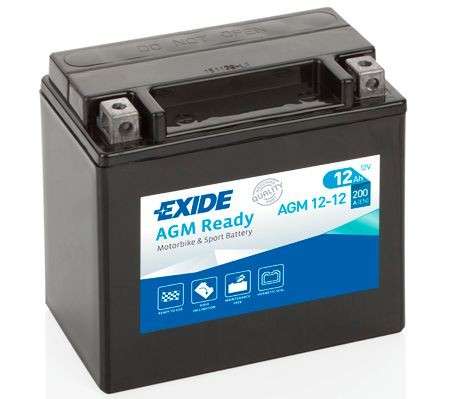
- Exide ETX14-BS or equivalent
- Varta equivalent AGM model
The exact battery should be confirmed against your bike, market and tray fitment, but the 51913 / YTX14-type size range is the normal reference point for many R1100S applications.

Good lithium choice: high-quality LiFePO₄
A suitable LiFePO₄ battery should have:
- Correct physical size
- Integrated BMS
- High genuine cranking power
- LiFePO₄-compatible charging requirements
- Enough reserve capacity for ABS-equipped use
The guide specifically mentions the SAITO SLFE-51913 and Shido Lithium 51913 as strong-fit lithium options for an R1100S, with the Shido 51913 described as a very good current alternative where the SAITO version is no longer available.
A current Shido 51913 listing also describes the battery as substantially lighter than lead-acid and highlights low self-discharge and higher starting capability.
Which One Should You Choose?
Choose AGM if:
- You tour
- You ride in cold weather
- You have iABS
- You want maximum reliability
- You use accessories
- You do not care about saving 3–4 kg
- You want the least complicated ownership experience
Choose lithium if:
- You ride mainly in warmer months
- You want to save weight
- You use a quality battery with proper BMS
- Your charging system is healthy
- You do not rely on a standard AGM/gel charger
- You accept that cold starts may need a brief “wake-up” load
Avoid lithium if:
- It is very cheap and vague about real cranking power
- It has no clear BMS information
- You ride through winter
- The bike has iABS and already suffers ABS self-test faults
- Your charging voltage has not been checked
Practical Buying Recommendation
For a normal R1100S:
Buy a good AGM and stop thinking about it.
For a well-maintained R1100S used mostly in spring, summer and autumn:
A high-quality LiFePO₄ battery is a sensible weight-saving upgrade.
For a 2003 R1100S with iABS:
AGM is the conservative choice. A strong lithium battery can work, but do not buy the cheapest one.
That is the real-world answer.
After Installation
Once the battery is installed:
- Check that the terminals are tight.
- Confirm that the battery is physically secure.
- Check charging voltage at idle and around 3,000 rpm.
- On ABS bikes, confirm the ABS self-test completes normally.
- If the battery was disconnected, open the throttle fully once or twice with ignition on before starting, so the Motronic can relearn throttle position.
BMW’s R1100S workshop manual also notes that disconnecting the battery clears stored Motronic values and that the throttle should be fully opened once or twice with ignition on before restarting.
Bottom Line
For the BMW R1100S, the best battery is the one that starts the boxer cleanly and keeps the ABS system happy.
AGM is heavier, but reliable.
Lithium is lighter, but more dependent on quality, temperature and correct charging.
For most riders, especially those with ABS II or iABS, AGM remains the default recommendation. For warm-weather riders who care about weight and choose a proper LiFePO₄ battery, lithium can be a very good upgrade.
Do not cheap out on the battery.
On an R1100S, low voltage has a way of becoming brake-warning lights, bad starts and unnecessary fault chasing.
Help Improve This Guide
Have you discovered a better method, spotted an error or have a useful tip for fellow owners? Leave a comment below. Every contribution helps make R1100S.eu the best BMW R1100S knowledge base on the web.