
The BMW R1100S was never an easy motorcycle to categorise.
It was too practical to be a pure superbike, too sporting to be a conventional BMW tourer, and too unusual to fit neatly beside Japanese V-fours or Italian twins. That ambiguity hurt it when new. It is exactly what makes it interesting now.
Built around BMW’s 1,085 cc Oilhead boxer, Telelever front suspension and Paralever shaft drive, the R1100S combined genuine long-distance ability with a riding position, chassis and visual identity aimed at riders who wanted something sharper than an R1100RS. BMW itself framed it as a modern successor in spirit to the R90S: a sporting boxer that could cover distance without becoming a one-dimensional sport bike.
BMW Motorrad Direct has confirmed that 33,741 R1100S motorcycles were produced and delivered worldwide between late 1997 and mid-2005. Of those, 4,673 were delivered to the United States.
That is not tiny production, but it is modest enough that the R1100S has become a properly distinctive modern classic. More importantly, it remains a motorcycle people actually ride.
The Basic Formula

The R1100S used BMW’s R259 Oilhead engine: an air- and oil-cooled, four-valve, 1,085 cc boxer twin with Bosch Motronic engine management, a six-speed gearbox and shaft drive.
BMW raised output over the R1100RS through revised engine management, higher-compression pistons and freer-breathing intake arrangements. The result was a claimed 98 hp at 7,500 rpm and 97 Nm at 5,750 rpm. It was never designed to chase high-revving four-cylinder sport bikes. Its appeal was torque, stability, low-effort speed and the distinct mechanical rhythm of the boxer engine.
The chassis was equally deliberate:
- Telelever front suspension
- Paralever single-sided shaft-drive rear suspension
- Six-speed gearbox
- Hydraulic dry clutch
- Aluminium front frame with load-bearing engine and gearbox
- Tubular steel rear frame
- Adjustable rebound damping front and rear
- Optional ABS, depending on market and model year

The R1100S also introduced a much more aggressive visual and ergonomic package than previous BMW boxers: clip-on handlebars, rear-set footrests, an underseat exhaust, a removable rear-seat cowl and asymmetric headlights. BMW had combined these elements in a way it had not previously used on a production boxer.
1998–1999: The Original R1100S
The R1100S was launched publicly in 1998 and sold in most markets as a 1999 model.
It immediately looked different from the rest of BMW’s range. The bodywork was compact, the front end was asymmetric, the exhaust sat beneath the seat and the riding position was clearly more committed than the R1100RS. It was still recognisably BMW, but it was BMW attempting a proper sport-tourer rather than simply fitting a fairing to a boxer roadster.
BMW’s own US material listed Night Black, Bright Red and Mandarin among the early colour options. In some markets, equipment and colour availability varied, so any exact colour list should always be treated as market-specific rather than universal.
Early technical specification
The early R1100S used:
- 1,085 cc Oilhead boxer engine
- 98 hp / 97 Nm claimed output
- Six-speed gearbox
- Shaft drive
- Dual 305 mm floating front brake discs with four-piston calipers
- 276 mm rear brake disc with two-piston caliper
- Conventional ABS II as an option on ABS-equipped models
- 5-inch rear wheel on standard versions
- 5.5-inch rear wheel on Sport versions
The 305 mm front-disc measurement matters. Many secondary sources incorrectly repeat 320 mm for all R1100S models, but the early bikes used 305 mm discs.
BMW quoted a kerb weight with fuel of approximately 229 kg, depending on equipment and market specification. It was not a lightweight sport bike, but the mass was carried low and the combination of Telelever stability, boxer torque and shaft-drive composure gave it a very distinctive road feel.


The 1999 Sport Version
BMW soon offered a more focused version of the original concept.
The R1100S Sport added a taller sport suspension specification and a wider 5.5-inch rear wheel. BMW described the changes as increasing cornering clearance and rear grip without compromising the bike’s overall touring competence.
This is important because many later special versions were effectively built around this Sport-specification foundation.
For collectors, the Sport version matters less because of a badge and more because it represents the R1100S in the form BMW clearly intended for more aggressive road use: higher ride height, wider rear wheel and a sharper visual stance.
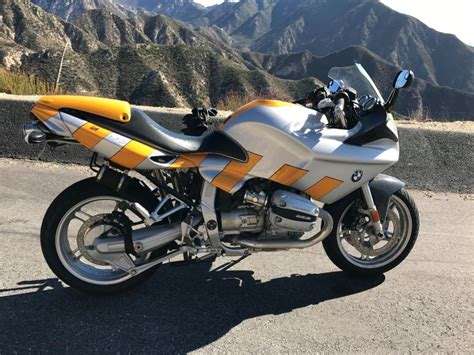
Mandarin/Silver Special Edition
BMW North America offered a Mandarin/Silver special edition limited to 200 examples. It combined the higher sport suspension and 5.5-inch rear wheel with a distinctive two-tone colour scheme.
This is a real documented limited edition, not a later dealer-created paint variation. It is one of the earliest examples of BMW recognising that the R1100S appealed to owners who wanted a more visibly sporting version of the model.
2000: Refinement Rather Than Reinvention
The 2000 model year was largely a continuation of the original formula.
BMW did not fundamentally redesign the R1100S. The major engine, chassis and styling elements remained intact. This is typical of the model’s production life: BMW developed it through equipment, suspension, brakes, electronics, colours and market-specific special editions rather than replacing the core motorcycle every year.
2001: The Integral ABS Transition
The major technical development came in 2001.
From approximately February 2001, BMW introduced the optional semi-integral, servo-assisted Integral ABS system on the R1100S. Earlier ABS-equipped bikes used ABS II.
This later system is often called:
- iABS
- Integral ABS
- servo ABS
- partially integral ABS
It is fundamentally different from ABS II.
With iABS, the front brake lever applies braking to both wheels, while the foot pedal continues to operate the rear brake only. The system uses an electro-hydraulic servo pump and separate control and wheel circuits. It delivers very strong braking with notably light lever effort, but it also requires a more complex service procedure and proper fluid maintenance.

The R1100SL / Light Editions
BMW offered Light or SL versions in certain markets. These are real BMW variants, but their exact specification and availability varied regionally.
The broad idea was straightforward: a more stripped, more focused R1100S with reduced weight or reduced touring equipment. BMW North America described the 2001 R1100SL as a black-on-black version that shed weight through carbon-fibre components.
There are also references to SAL or Light editions in owner communities, sometimes accompanied by precise production claims. These numbers should be treated carefully.
Some owners quote production totals around 200, while other figures differ. BMW has not published a broadly accepted definitive total for every Light/SAL variation. Unless supported by original market documentation or BMW build data, exact production-number claims should be labelled as owner-reported rather than fact.

2002: BoxerCup Becomes a Road Bike
The R1100S had already proven itself in BMW’s BoxerCup racing programme. By 2002, BMW began translating that racing identity into road-going versions.
This was not one single global model.
Different markets received different BoxerCup-related versions, and this is where many later guides become inaccurate by treating every BoxerCup bike as identical.
2002 US R1100S BoxerCup
BMW North America introduced the R1100S BoxerCup in Titan Silver Metallic.
It included:
- Larger battery and alternator
- Sport suspension
- 5.5-inch rear wheel
- Low handlebars
- No ABS
BMW positioned it as a US-market variation inspired by the International BoxerCup race series.
This is important because it predates the later Pacific Blue/Alpine White BoxerCup Replika familiar to many collectors.
2002 UK BoxerCup Replica
BMW Motorrad Great Britain created a separate UK-only run of 25 R1100S BoxerCup Replica machines.
These were based on the R1100S Sport and then modified by BMW UK. They were numbered with stainless-steel top-yoke badges and featured Alpine White and red paintwork, blue wheel rims, a motorsport belly pan, black engine and transmission finish, heated grips and a road-going BoxerCup-style lower spoiler.
They also came with supplementary equipment fitted at the first service:
- Laser Inox E4-approved silencer
- Y-piece collector
- ECU
- Goodridge stainless brake lines
That makes the UK 2002 BoxerCup Replica a particularly interesting special case. It is not simply an early version of the later global BCR concept; it is a specific BMW UK programme with its own documented identity.
2003: BoxerCup Replika and BoxerCup Prep
For 2003, BMW brought the BoxerCup identity much more clearly into the mainstream.
The US market received two important variants:
- R1100S BoxerCup Replika
- R1100S BoxerCup Prep
They should not be treated as the same motorcycle.
2003 BoxerCup Replika
The 2003 US BoxerCup Replika was limited to 200 units.
It used Pacific Blue and Alpine White race-inspired graphics based on the BoxerCup machine associated with Randy Mamola. BMW also specified:
- Clear turn-signal lenses
- Carbon-fibre cylinder-head covers
- Lower engine spoiler
- No ABS
BMW described it as a road-going celebration of the BoxerCup race series rather than as a mechanically identical race bike.
The Pacific Blue/Alpine White livery is now the visual shorthand many people associate with the R1100S BoxerCup Replika, but it is important to remember that the exact graphics, equipment and production numbers vary between markets and years.
2003 BoxerCup Prep
The BoxerCup Prep was the more track-oriented companion version.
BMW North America described it as a lightweight R1100S without ABS, fitted with:
- High-output alternator
- Sport suspension
- 5.5-inch rear wheel
- Titan Silver Metallic or Titan Grey/Mandarin Metallic colour schemes
It was intended as the basis for riders who wanted a more directly race-oriented starting point.
What it was not is automatically “mechanically identical” to every BoxerCup Replika.
That claim appears regularly in owner discussions, but BMW’s published US specification does not establish identical Öhlins suspension, identical gearing, identical exhaust or identical ECU settings across all BCR and Prep variants. The safe conclusion is that the Prep was a more focused, ABS-free R1100S with sport equipment, but specification must be checked market by market.
2004: The New BoxerCup Replika
For 2004, BMW introduced a revised BoxerCup Replika with much closer visual and technical association to the race machinery.
BMW’s official material confirms:
- New three-colour race livery
- Twin-spark ignition
- Higher chassis specification derived from the race-bike layout
- Laser sport silencer modified for road legality
- White instrument dials
- Higher seat
- Removable mirrors derived from the R1150GS
BMW also stated that the engine output remained at standard R1100S level. The BCR was not a higher-horsepower engine package; its appeal was chassis stance, equipment, visual identity and connection to BoxerCup racing.
For European-market 2004 BCRs, BMW’s own material states that ABS was no longer offered. That does not automatically describe every market worldwide, so US, UK and European bikes should always be documented separately.

Randy Mamola Connection
Randy Mamola was the official ambassador and public face of the BMW Motorrad BoxerCup during this period.
His association with the series is real and significant. He was not simply added later as a marketing name; BMW repeatedly used him as ambassador, rider and public figure around the BoxerCup programme.
However, owners should be careful with “Randy Mamola Edition” terminology.
Some markets received bikes with graphics inspired by Mamola’s race machine. Some US-market BoxerCup Replikas were explicitly promoted as using graphics based on the BoxerCup race bike he rode. But the exact use of signatures, decals, production totals and equipment packages varied.
A bike should not be declared a genuine Randy Mamola edition based on colour alone. Check original documentation, model designation, market specification and equipment.

2005: Final Production Year
The R1100S continued into 2005, but by then BMW’s attention was moving toward the next generation of boxer sport bikes.
The 2005 US BoxerCup Replika is especially notable because BMW announced a run of 300 units for the US market. It used Pacific Blue, Red and Alpine White graphics inspired by the BoxerCup race bike ridden by Randy Mamola, plus clear indicators, carbon cylinder-head covers and a lower engine spoiler.
BMW also continued to offer the standard R1100S with a broad option structure, including items such as partial Integral ABS, wider rear wheel, sport suspension, sport transmission, heated grips and pannier mounts. This is one reason specification varies so much between apparently similar bikes.
The R1100S ended production around mid-2005. Its successor, the R1200S, was a different proposition: lighter, more powerful and more conventionally sport-oriented. But it did not replace the R1100S’s particular blend of long-distance practicality, Oilhead character and slightly eccentric BMW engineering.
Standard R1100S, Sport, BoxerCup and Replika: What Matters Today
The hierarchy is not as simple as “BCR good, standard bike less good.”
A good standard R1100S with documented maintenance can be a better ownership proposition than a neglected BoxerCup Replika with incorrect parts and uncertain history.
When assessing a bike today, separate these questions:
Is it mechanically healthy?
Check:
- Clutch slave cylinder history
- Final-drive condition
- Paralever pivots
- Fuel lines and quick disconnects
- In-tank hoses and fuel filter
- Hall sensor wiring
- Brake-system type and service history
- Suspension age and condition
- Throttle-body wear
- Cam-chain tensioner upgrade
- Battery and charging system
Is it correctly specified?
Check:
- Wheel width
- Suspension type
- Exhaust system
- Colour and graphics
- Engine and gearbox finish
- Carbon parts
- Instruments
- Seat and rear cowl
- ABS specification
- Factory options
- Correct mirrors and indicators
Is it genuinely a special edition?
Check:
- VIN and BMW build data
- Original sales documentation
- Numbered plaques where applicable
- Market-specific brochures
- Correct paint and decals
- Correct equipment
- Provenance
A bike with a BoxerCup paint kit is not automatically a BoxerCup Replika. A bike with a high seat and Laser exhaust is not automatically a 2004 BCR. The details matter.
Colours and Market Variations
Colour charts for the R1100S are useful, but they are rarely definitive.
BMW offered different colour combinations, equipment packages and special editions across Europe, the United Kingdom, North America and other markets. A colour available in Germany may not have been available in the US. A UK-only special edition may share visual elements with a broader BoxerCup model without being the same bike.
The right wording for any R1100S colour guide is:
Colour availability varied by market, production date and local BMW importer specification. Use VIN information, original brochures and factory documentation to confirm an individual motorcycle.
That is more useful than presenting one universal list that will inevitably contain exceptions.
VINs and Model Identification
The VIN is valuable, but it is not enough on its own.
The 10th character can be useful as a model-year guide, particularly on US-market bikes, but it does not reliably establish:
- Exact production month
- ABS type
- Special-edition status
- Original factory options
- Market-specific equipment
- Whether a bike has been repainted or modified
For a serious purchase, use the full VIN alongside BMW build information, original registration documents, market brochures and visible equipment.
The motorcycle itself still matters. An early R1100S may have later brakes. A standard bike may have Sport suspension. A BCR may have lost its original exhaust or bodywork. A VIN tells you the starting point; it does not tell you the complete life story.
Why the R1100S Matters
The R1100S is not perfect.
It is heavier than a modern sport bike. The engine is not smooth in the way a four-cylinder is smooth. The shaft drive is not as delicate or immediate as a chain. Telelever feedback is different from telescopic forks. Servo ABS, where fitted, divides owners. Some original parts are becoming expensive.
But none of that explains why people keep these motorcycles.
The R1100S matters because it does something few motorcycles manage convincingly: it feels like a sport bike without becoming useless after two hours. It can cover a continent with panniers, then feel genuinely entertaining on a mountain road. It has racing heritage without pretending to be a race replica in every form. It has boxer character without being a nostalgic airhead.
BMW built a motorcycle that was neither fish nor fowl at the time.
Twenty years later, that is precisely its strength.
Production Summary
- Production period: late 1997 to mid-2005
- Worldwide production: 33,741 units
- US-market bikes: 4,673 units
- Core engine: 1,085 cc Oilhead boxer
- Claimed output: 98 hp / 97 Nm
- Transmission: six-speed, shaft drive
- Front suspension: Telelever
- Rear suspension: Paralever
- Early ABS: ABS II
- Later ABS option: semi-integral servo-assisted Integral ABS / iABS
- Special variants: Sport, Light/SL, BoxerCup, BoxerCup Prep, BoxerCup Replika and market-specific limited editions